She Arrived as a Mail-Order Bride—Before She Could Leave, a Cowboy Said, “She’s Mine.”

Chapter 13
Twenty years after Eleanor first arrived, the house was still standing.
The white paint had faded.
The porch boards had been replaced twice.
The barn had grown larger.
The pasture stretched farther.
But the front door remained the same.
Samuel had refused to replace it.
“This is the door you walked through,” he always said.
Eleanor thought that was sentimental.
She secretly loved it.
Their daughter Ruth married a schoolteacher.
Their son Jonathan took over much of the farm.
Grandchildren filled the house during holidays.
The once-quiet rooms became crowded with laughter.
One winter evening, Eleanor sat beside the fireplace with the old family Bible in her lap.
The documents were still inside.
Her father’s letters.
The survey.
The evidence that had changed everything.
Samuel entered carrying firewood.
His beard was gray now.
His shoulders were not as straight.
But his eyes were the same.
He placed the wood beside the fireplace.
“You still have that?”
Eleanor smiled.
“Of course.”
“You’ve read it a hundred times.”
“Maybe more.”
He sat beside her.
She leaned against him.
“Do you ever wonder what would have happened if Carter had won?”
Samuel looked into the fire.
“Yes.”
“And?”
“I think we would have rebuilt somewhere else.”
She smiled.
“Together?”
“Always.”
The door opened.
Their youngest granddaughter rushed inside.
“Grandmother!”
Eleanor laughed.
“What?”
“Mother says supper is ready.”
Samuel stood.
“Then we’d better go.”
The little girl looked at him.
“Grandfather?”
“Yes?”
“Is this your house?”
Samuel looked around.
The room.
The photographs.
The wooden table.
The Bible.
The worn floor.
Then he looked at Eleanor.
She already knew the answer.
“No.”
The child frowned.
“No?”
Samuel smiled.
“It’s ours.”
The girl ran toward the dining room.
Eleanor followed slowly.
At the doorway, she stopped.
She looked back at the room.
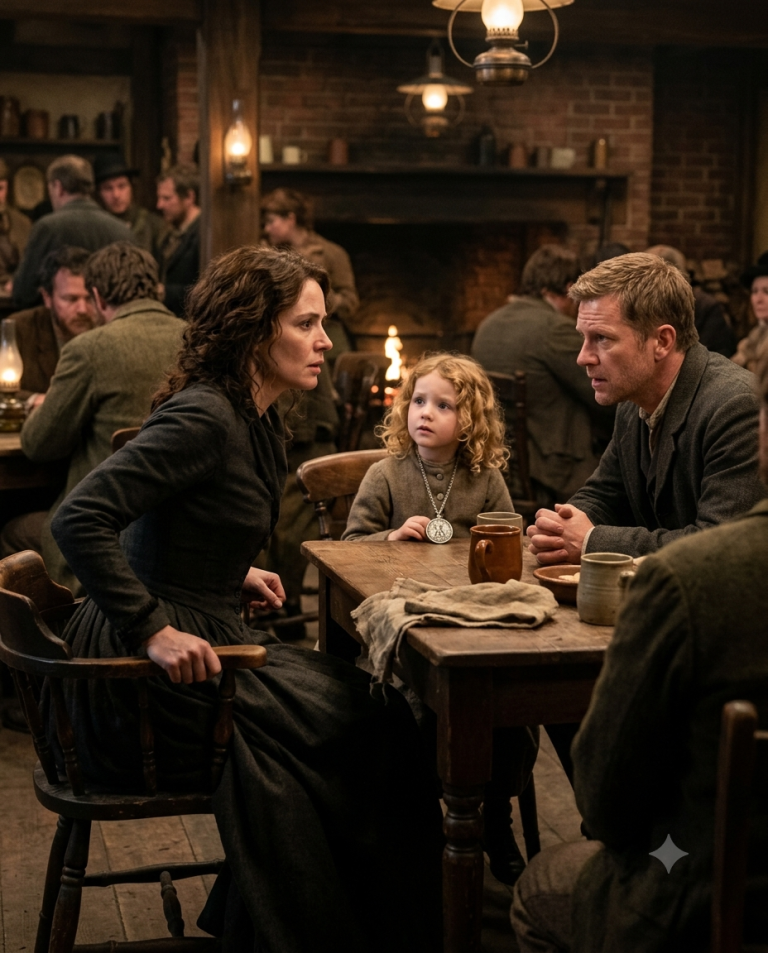
Twenty years earlier, she had arrived with one trunk and no certainty that she would remain until morning.
She had been afraid.
Samuel had been wounded.
Carter had threatened them.
The land had been stolen.
The barn had burned.
People had lied.
Men had tried to frighten them apart.
Yet none of it had lasted.
Because a house could survive fire.
A marriage could survive fear.
And people could survive injustice when they refused to stand alone.
Samuel appeared beside her.
“You coming?”
“In a moment.”
He reached for her hand.
She took it.
Then they walked together toward the warm light of the dining room.
Eleanor had once arrived as a bride who belonged nowhere.
She had expected a husband.
Instead, she found a man who gave her freedom.
She expected a house.
Instead, she found a home.
And the greatest surprise of all was that the man who once said, “She’s mine,” never meant that she belonged to him.
He meant that, if she chose him, he would spend the rest of his life standing beside her.
And she had chosen him.
Every day since.