A Rancher Posed as a Drifter—A Widow Shared Her Last Bread Without Knowing His Secret

Chapter 1
The stranger arrived at the widow’s cabin just before sunset, when the sky over Virginia Colony had turned the color of old copper.
He looked like a man who had lost everything.
His coat was torn at one shoulder. Mud covered his boots. His horse was nowhere to be seen. A dark bruise ran along his jaw, and the brim of his hat hid most of his face.
He stopped at the edge of the widow’s small field and raised both hands.
“Ma’am,” he called, his voice rough from cold and exhaustion. “I’m not looking for trouble.”
The widow stood in the doorway with a wood-handled axe beside her.
She studied him without blinking.
“You’re standing on my land.”
“Yes, ma’am.”
“Then you’ve already found trouble.”
For the first time, something almost like a smile touched his face.
“I reckon I have.”
The widow tightened her grip on the axe.
She had learned not to trust men who appeared at dusk.
Three years earlier, her husband had died of fever, leaving her with a seven-year-old son, a half-broken cabin, six acres of rocky soil, and debts that seemed to grow faster than weeds.
She had survived by learning one simple rule:
Never give a stranger more than he could take.
The stranger looked toward the cabin.
“I haven’t eaten since yesterday.”
She hesitated.
Inside, there was half a loaf of corn bread.
Not enough for three people.
Her son, Thomas, had already asked twice whether there would be supper.
The widow glanced at the stranger’s hollow cheeks.
Then she sighed.
“Wait there.”
She disappeared inside.
A moment later, she returned carrying a wooden plate.
On it sat half the remaining bread.
The stranger stared at it.
“You’re giving me all that?”
“Half.”
He looked at the plate again.
Then at her.
“You sure?”
“No.”
That surprised him.
The widow held the plate toward him.
“But my boy can eat tomorrow if he has to.”
The stranger slowly accepted the bread.
Thomas appeared behind his mother.
“Ma?”
“Go inside.”
The boy looked at the stranger.
“Is he a thief?”
The stranger almost laughed.
“Not tonight.”
The widow frowned.
“You planning on staying?”
“No.”
“Good.”
The stranger took one bite.
Then another.
He ate slowly, as though each mouthful meant something.
The widow watched him carefully.
There was something strange about the man.
His hands were rough, but not like a laborer’s. There were old scars across his knuckles. His boots were worn but made of excellent leather. His posture was too straight for a common drifter.
And when Thomas dropped a piece of firewood beside the door, the stranger instinctively reached for the boy.
Not himself.
The boy.
The widow noticed.
So did the stranger.
Their eyes met.
He lowered his hand.
“My name’s Daniel,” he said.
The widow said nothing.
After a moment, she finally replied.
“Eleanor.”
She didn’t tell him her last name.
He didn’t ask.
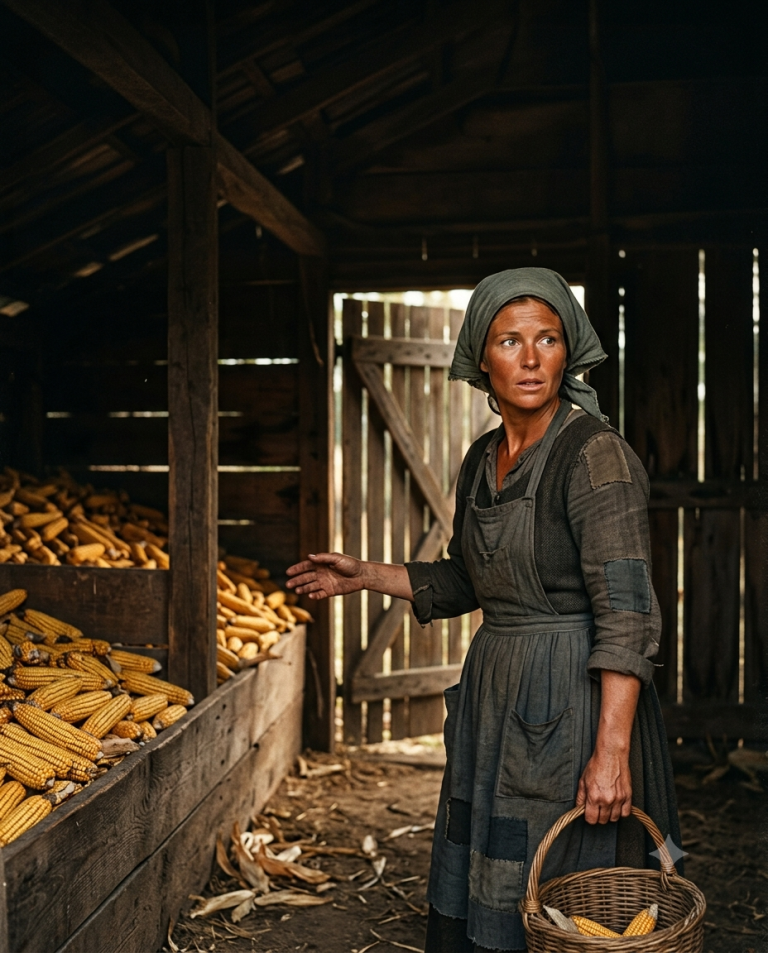
That night, Eleanor let Daniel sleep in the barn.
She gave him an old blanket.
Nothing more.
But long after the fire had gone low, Eleanor stood at the cabin window and watched him through the darkness.
The stranger was supposed to be sleeping.
Instead, he was sitting against the barn wall, staring toward the distant hills.
And for one brief moment, illuminated by moonlight, Eleanor saw something beneath his torn coat.
A silver chain.
Hanging from it was a small iron key.
Daniel quickly tucked it away.
Eleanor stepped back from the window.
She had no idea that the man sleeping in her barn was not a drifter at all.
He was one of the wealthiest ranchers in three counties.
And he had come to her valley because someone was trying to steal everything he owned.